
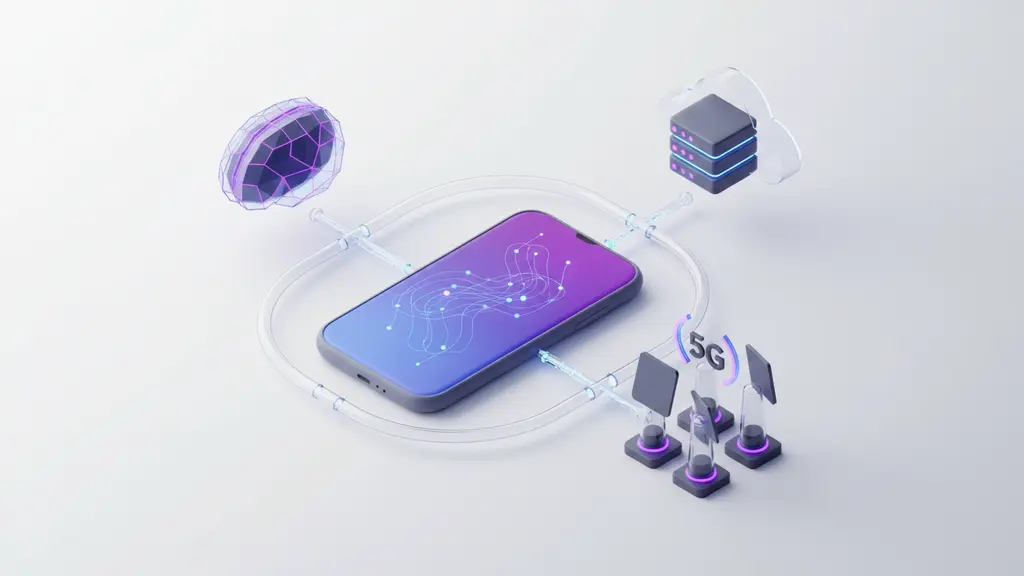
Mobile applications continue to evolve from simple digital tools into intelligent platforms that influence how people shop, communicate, work, learn, manage finances, and interact with businesses. In 2026, app development is increasingly focused on intelligence, personalization, security, speed, and seamless experiences across devices. Current industry discussions consistently highlight artificial intelligence, cross-platform development, edge computing, privacy-first architecture, immersive interfaces, and automation as important directions for modern mobile products.
Contents
ToggleFor businesses, keeping up with these developments is no longer simply about adding the newest technology. The goal is to select technologies that solve genuine user problems while creating applications that are reliable, scalable, secure, and easy to maintain. This is where professional mobile app development becomes particularly important.
Artificial Intelligence Becomes Part of the App Experience
Artificial intelligence is one of the strongest forces influencing mobile applications in 2026. Rather than treating AI as an optional feature, development teams are increasingly considering it during product planning and architecture.
AI can support personalized recommendations, intelligent search, automated customer assistance, predictive analytics, content generation, fraud detection, and workflow automation. This allows applications to respond more intelligently to individual users instead of providing exactly the same experience to everyone.
The shift toward AI-native applications also means developers need to think carefully about model selection, data handling, latency, cost, and responsible use. Simply adding an AI chatbot does not automatically make an application innovative. The technology should have a clear purpose and measurable value.
On-Device AI Improves Privacy and Responsiveness
Another important development is the movement of certain AI workloads from remote servers toward mobile devices. On-device intelligence can reduce dependence on constant cloud communication and can make selected features faster or more private.
Recent advances in mobile computing are making continuous AI processing increasingly practical for applications involving speech recognition, translation, image processing, gaming, and other demanding workloads.
Developers must still balance processing requirements with battery consumption, device capabilities, storage, and model size. Professional applications therefore need carefully optimized AI architectures rather than simply placing large models directly on every device.
Cross-Platform Development Continues to Mature
Businesses increasingly want applications that reach both major mobile platforms without maintaining completely separate development efforts. Cross-platform technologies have consequently become an important part of the modern development landscape.
The objective is not merely to write code once. A successful cross-platform application must still provide strong performance, appropriate platform behavior, responsive interfaces, and access to important device capabilities.
For many products, a shared architecture can reduce duplicated development work and simplify maintenance. However, applications that depend heavily on specialized hardware or platform-specific functionality may still benefit from native development.
Edge Computing Supports Faster Mobile Experiences
Mobile applications increasingly depend on real-time interactions. Sending every request to a distant cloud server can introduce latency, especially when applications process large quantities of data.
Edge computing addresses part of this challenge by moving processing closer to users or devices. Combined with increasingly capable mobile hardware and modern networks, edge technologies can support faster responses and more reliable experiences. Industry discussions around 2026 mobile development increasingly connect edge computing with offline functionality, lower latency, and improved application performance.
This can be particularly useful for applications involving IoT devices, real-time analytics, gaming, connected vehicles, industrial systems, and location-based services.
Privacy and Security Become Core Development Requirements
Users are becoming more conscious of how applications collect, store, and use personal information. As a result, privacy can no longer be treated as something developers address immediately before launch.
Modern development increasingly incorporates privacy and security into the architecture from the beginning. Zero-trust approaches, stronger authentication, encryption, secure APIs, permission management, and careful data minimization can all contribute to a safer application.
Privacy-first design also helps businesses build user confidence. An application that performs well but handles sensitive information carelessly can quickly damage a company’s reputation.
Hyper-Personalized User Experiences
Personalization is moving beyond basic recommendations. Modern applications can use behavioral information, preferences, contextual signals, and interaction history to create more relevant experiences.
For example, a shopping application may personalize product discovery, while a financial application might organize information according to individual user priorities. A learning platform can adjust content based on progress and engagement.
However, personalization must remain transparent and respectful. Users should have meaningful control over their data and preferences. The strongest applications combine intelligent personalization with clear privacy practices.
Multimodal and Conversational Interfaces
Mobile interaction is also expanding beyond traditional buttons, menus, and text fields. Voice, images, natural-language commands, and conversational interfaces are becoming increasingly relevant.
Users may expect an application to understand a spoken request, interpret an uploaded image, or respond through a natural conversation. This can make complicated workflows easier, particularly when users are operating an application while moving, working, or performing another task.
Multimodal design should complement traditional interfaces rather than eliminate them. Users still need clear navigation, visual feedback, accessibility, and predictable controls.
Super Apps and Connected Ecosystems
Another trend receiving attention in 2026 is the development of broader application ecosystems. Instead of building an application around one isolated function, companies may connect payments, communication, shopping, services, loyalty programs, and other capabilities within a single environment.
Super-app strategies can increase engagement because users have fewer reasons to leave the platform. However, they also introduce considerable architectural complexity. Developers must carefully manage permissions, integrations, performance, security, and user experience.
For smaller businesses, a focused application may still be more effective than trying to replicate a super-app model.
Spatial Computing and Immersive Experiences
Augmented reality and spatial computing continue to create opportunities for mobile experiences that connect digital information with physical environments.
Retailers can use augmented reality to help customers visualize products. Education platforms can create interactive learning environments. Real-estate applications can offer immersive property experiences, while industrial applications can overlay instructions onto physical equipment.
The key challenge is ensuring that immersive technology serves a practical purpose. Technology should improve the experience rather than become a novelty that users quickly abandon.
Smarter Testing and Automated Development Workflows
Artificial intelligence is also changing the development process itself. Development teams can increasingly use AI-assisted tools for code generation, debugging, testing, documentation, and analysis.
Automated testing and continuous integration can help teams identify problems earlier in the development cycle. Automated monitoring can also reveal performance issues and unusual application behavior after release.
These tools do not eliminate the need for experienced developers. Instead, they allow professionals to spend more time on architecture, product decisions, security, usability, and complex technical challenges.
Low-Code and No-Code Tools Find Their Place
Low-code and no-code platforms are becoming useful for prototypes, internal applications, business workflows, and simple digital products. They can help organizations experiment with ideas without building every component from scratch.
However, complex consumer applications often require customization that low-code platforms cannot provide easily. Scalability, performance, security, integrations, and specialized functionality may eventually require traditional development.
The likely direction is not a complete replacement of professional coding but a combination of automated tools and expert engineering.
Sustainable and Efficient App Engineering
Application performance increasingly has an environmental and financial dimension. Inefficient applications can consume unnecessary battery power, network bandwidth, storage, and computing resources.
Developers are therefore paying greater attention to efficient data transfers, optimized images and media, intelligent caching, lightweight interfaces, and efficient backend processing.
Better efficiency can benefit both sustainability and users. An application that loads quickly and consumes less battery is generally more pleasant to use.
Accessibility Becomes a Standard Expectation
Professional applications need to work for users with different abilities and preferences. Accessibility can involve readable typography, appropriate contrast, screen-reader compatibility, keyboard support where relevant, captions, clear navigation, and interfaces that do not depend entirely on one type of interaction.
Accessibility should be incorporated during design and testing rather than added as an afterthought. Doing so can improve usability for a much broader audience.
Why These Trends Matter for Businesses
The trends shaping mobile development in 2026 point toward a broader change in how companies approach applications. Businesses are no longer competing only on the number of features they can offer.
They are competing on how intelligently, securely, quickly, and conveniently those features work.
A professional development team can evaluate which technologies actually support business objectives. Instead of adding AI, AR, edge computing, or other technologies simply because they are popular, developers can determine whether each technology improves the product and justifies its complexity.
Preparing for the Future of Mobile Applications
Companies planning a new application should begin with user needs and business objectives rather than technology alone. From there, teams can determine the appropriate architecture, platform strategy, security model, integrations, testing process, and long-term maintenance plan.
The most successful applications of 2026 are likely to be those that combine intelligent functionality with reliable fundamentals. Fast performance, intuitive design, strong security, accessibility, scalability, and dependable support remain just as important as emerging technologies.
Conclusion
The mobile application landscape in 2026 is becoming more intelligent, connected, personalized, and security-conscious. AI and on-device intelligence are expanding what applications can accomplish, while cross-platform development, edge computing, automation, immersive interfaces, and privacy-first engineering are changing how applications are designed and delivered.
For organizations that want to remain competitive, following every trend is not the answer. The better approach is to identify technologies that genuinely improve the customer experience and support long-term business goals. With thoughtful planning and professional mobile app development, businesses can build applications that are not only relevant in 2026 but also prepared for the technologies and expectations that come next.