
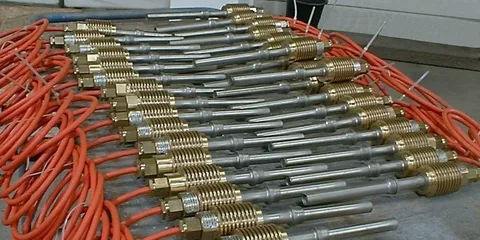
Efficiency in thermal processing depends on far more than just supplying heat; it depends on delivering the right amount of watt density in the right way. Industrial heating accessories behave differently under varying loads, and their performance shifts based on how heat moves, how components respond, and how fast each stage must occur. Understanding these factors helps ensure heating systems remain reliable, consistent, and suited to demanding industrial environments.
Material Thermal Conductivity and Heat Capacity
Different materials absorb and release heat at dramatically different rates. Metals with high thermal conductivity allow energy from cartridge heaters to move quickly through the workpiece, which supports higher watt loading without risking surface damage. In contrast, plastics and low-conductivity materials require lower densities because heat disperses slowly, increasing the risk of uneven heating.
Heat capacity also shapes watt density decisions, as materials that store more heat require additional energy to reach target temperatures. Industrial heating products must account for how much energy the workpiece can safely absorb before structural changes occur. Matching watt density to these material characteristics protects product integrity and ensures predictable process performance.
Target Temperature Range for Process Efficiency
Every heating application has an ideal temperature range that supports its intended purpose. Higher temperature ranges typically require industrial heaters USA to operate with greater watt densities so the system can overcome heat losses and maintain uniform temperatures. Reaching these high ranges quickly prevents thermal lag, which can disrupt production timelines.
Lower temperature processes operate differently because excessive watt density risks overshooting targets. The heating load must be gentle enough to maintain close control, especially for sensitive materials. Custom industrial heaters are often tailored to meet these precise requirements, allowing users to achieve the intended temperature range without unnecessary fluctuations.
Operating Environment Ambient and Airflow Conditions
Ambient conditions directly influence heater performance. Cold or drafty environments force industrial heating accessories to work harder because heat dissipates into the surrounding air. Higher watt densities may be required to counter these losses and maintain stable temperatures across the workpiece.
Airflow patterns also matter. Forced air, ventilation, or rapid air movement can draw heat away from heating elements, reducing thermal efficiency. Systems placed in controlled environments can use lower watt densities, but applications exposed to constant air movement may need industrial heating elements manufacturer–grade components designed for consistent performance in these harsher conditions.
Surface Area Contact Between Heater and Workpiece
Heat transfer depends heavily on the contact surface between heater and part. A snug fit ensures energy moves efficiently and evenly, allowing cartridge heaters to operate at higher watt densities without hotspots. Poor contact or air gaps restrict heat flow, forcing heaters to work harder and increasing the risk of premature failure.
Applications involving curved, irregular, or delicate surfaces require careful watt density adjustments. Larger contact areas often support higher loads, while smaller contact points need reduced watt densities to avoid overheating. These decisions influence both the safety and lifespan of the industrial heating accessories involved.
Duty Cycle Length and Frequency of Use
Duty cycles determine how long heaters remain energized before cooling periods. Continuous operation demands lower watt densities to prevent thermal stress and extend operating life. Industrial heaters USA used in nonstop applications must stay within safe limits, especially when exposed to long shifts or intense production demands.
Short and intermittent cycles allow higher watt densities because heaters receive periodic cooling breaks. However, this still requires careful calibration, as excessive peaks can cause thermal shock. Understanding duty cycle patterns ensures heaters deliver consistent thermal performance over extended use.
Maximum Allowable Component Temperature Limits
Each heating element and surrounding component has limits on how much heat it can withstand. Exceeding these limits reduces efficiency and shortens service life. Manufacturers specify internal temperature ratings that guide watt density choices for industrial heating products.
Staying within these boundaries prevents insulation breakdown, oxidation, and internal wire stress. Users must consider not only the heating element itself but also adjoining components such as housings, leads, and mounting hardware. Proper watt loading protects both the heater and the system it powers.
Voltage and Current Supply Stability
Electrical stability plays a significant role in watt density performance. Fluctuating voltage causes unpredictable heat output, which disrupts controlled processes and increases wear on cartridge heaters. A stable power source supports accurate thermal output and prevents sudden spikes that exceed material tolerances.
Facilities with inconsistent electrical systems may need lower watt densities or specialized industrial heating accessories designed to handle variability. Strong electrical infrastructure ensures heaters deliver consistent results across repeated cycles without stressing internal components.
Heater Geometry and Element Spacing Design
Geometry influences how heat spreads across a workpiece. Heaters with tightly spaced elements produce concentrated heat, supporting higher watt densities in evenly conductive materials. Wider-spaced elements produce softer heat distribution, useful for broader surfaces or sensitive substrates.
Designers often adjust shape, spacing, and configuration to match each application. Custom industrial heaters created for specific processes take these factors into account, ensuring watt density aligns with expected thermal patterns rather than arbitrary output targets.
Desired Heat-up and Cool-down Speed Profiles
Processes that require rapid heat-up benefit from higher watt densities, allowing industrial heating products to achieve setpoints quickly. Fast heating shortens cycle times and keeps production schedules efficient. However, the load must still match the material’s tolerance to avoid stress or warping during rapid expansion.
Cooling needs also influence watt density. Systems requiring controlled cool-down avoid extreme heat spikes, allowing materials to settle gradually. Faster cool-down processes may rely on specific geometry or heat dispersion strategies. Thermal Corporation provides custom solutions that align watt density with real-world performance needs across diverse applications.